Formerly SiNAPTIC Technologies

Additive Ceramics Materials

Advanced ceramic materials engineered for additive manufacturing, performance, and scalability.

OEM Additive Manufacturing
Materials Innovation

Tailored to Your Specific Project Needs

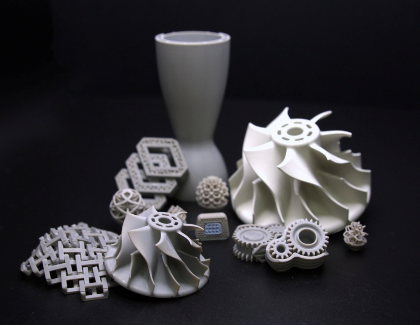
Adva Cera delivers Additive Ceramics materials developed specifically for ceramic additive manufacturing applications where performance, reliability, and precision are critical. Our materials innovation goes beyond processing—supporting OEMs and researchers with ceramic systems designed to perform in extreme environments.

Our Additive Ceramics portfolio includes advanced ceramic formulations optimized for high-temperature resistance, chemical stability, mechanical strength, and repeatability in additive manufacturing workflows. By aligning material development with printing, sintering, and validation processes, Adva Cera ensures material systems are production-ready and application-driven.

Materials Innovation

For Additive Ceramics

Our approach to Additive Ceramics focuses on tailoring material properties to specific application requirements. From early-stage development through production qualification, we work closely with customers to ensure ceramic materials meet functional, environmental, and performance demands.

Additive manufacturing enables new ceramic geometries and part designs, but material performance remains critical. Adva Cera’s materials expertise ensures consistency, density, and mechanical integrity throughout the additive manufacturing and sintering process.

Bio Ceramics

Our Additive Ceramics portfolio includes bio-ceramic materials engineered for medical and dental applications requiring biocompatibility and controlled material performance.

Tricalcium Phosphate (TCP)

Tricalcium Phosphate exhibits excellent biocompatibility, bioresorbability and osteoconductivity, making it an optimal material for bone substitution in regenerative medicine. Due to its properties, it is possible to manufacture patient-specific resorbable implants with defined pore structures and geometries using this material. During the healing phase, these implants are designed to be resorbed by the body and be replaced by native bone tissue.

Applications
Ideal for patient-specific biomedical applications in spine, dental, and orthopaedic anatomies.
Bio Ceramics

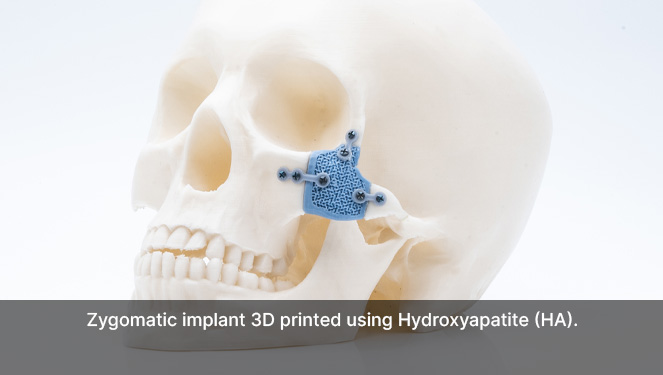
Hydroxyapatite (HA)

Hydroxyapatite is a naturally occurring mineral that forms the main component of bones. HA has excellent biocompatibility and osteoconductivity, making it an optimal material to use in bioresorbable implants with well-defined, porous and patient-specific geometries. Since HA is fully absorbably, once scaffold has been implanted in the body, bone cells will grow through it, gradually resorbing the material and replacing it with newly formed natural bone.

Applications
Ideal for patient-specific biomedical applications in spine, dental, and orthopaedic anatomies.
hydroxyapatide

Oxides

Oxide-based Additive Ceramics provide excellent thermal stability, electrical insulation, and wear resistance for a wide range of industrial and electronic applications.

Alumina (AI2O3)

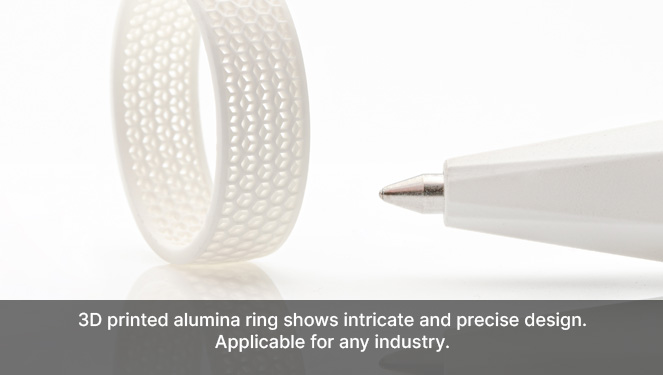
Alumina contains one of the most important oxide ceramic materials and is characterized by its desirable properties, including high hardness, corrosion, and temperature resistance. Components made of alumina are electrically insulating and puncture-proof, making them suitable for a wide range of applications such as substrates in the electronics industry among many others.

Applications
Alumina can be 3D printed for applications in industries such as dentistry and aerospace, where its exceptional hardness, chemical resistance, and biocompatibility make it ideal for producing dental implants and high-strength components for spacecraft and aircraft.
alumina

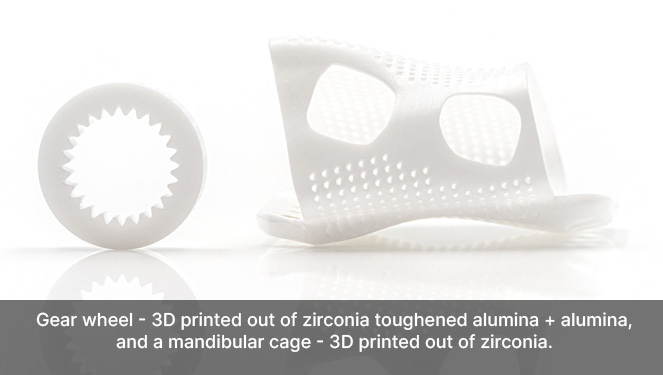
Zirconia (ZrO2)

Zirconia, dubbed ‘ceramic steel’, offers a combination of high hardness, wear and corrosion resistance, and exhibits one of the highest fracture toughness values among all ceramic materials. Its high thermal expansion and unique resistance to crack propagation make it an excellent material for joining with metals like steel. The biocompatibility of zirconia also facilitates its use in medical applications, such as for dental implants or for orthopaedic implants.
Applications
In addition to dental prosthetics and orthopedic implants, zirconia is also used for a wide range of industrial applications such as manufacturing cutting tools, wear-resistant components for heavy machinery, and high-temperature insulating parts, thanks to its outstanding hardness, thermal stability, and resistance to abrasion.
zirconia

Nitrides

Nitride Additive Ceramics are engineered for extreme thermal, mechanical, and chemical performance. These materials are commonly used in applications where strength, thermal conductivity, and durability are critical.

Silicon Nitride (Si3N4)

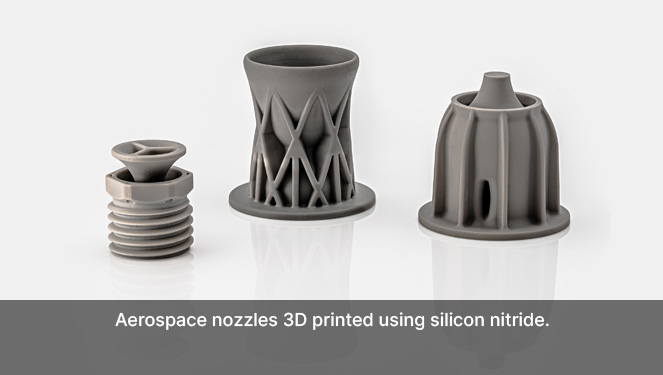
Silicon nitride exhibits superior material properties such as high strength, high toughness, thermal shock resistance and good chemical resistance to corrosion by many acids and alkalis. This material also stands out as a leading choice for orthopaedic implants due to its remarkable surface chemistry and nanostructure that has antibiofouling and osseointegrative properties to support bone growth.

Applications
Applications include the following industries: transportation, aerospace and defense, energy, electronics, semiconductors, and biomedical, spinal and orthopaedic implants.
silicon-nitrides

Aluminum Nitride (AIN)*

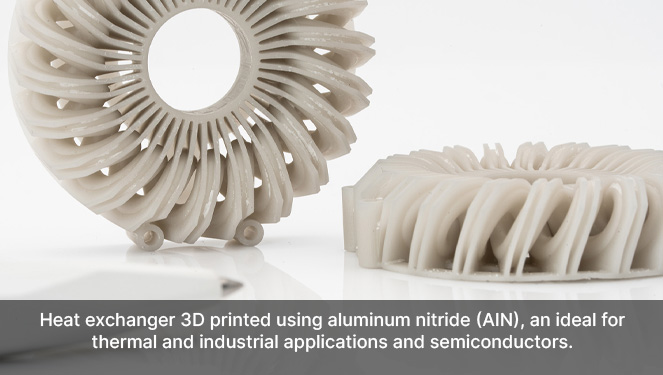
Aluminum nitride is the perfect high-performance ceramic material for thermal applications. The density and thermal conductivity of additively manufactured aluminum nitride components matches that of conventionally produced parts, while properties including a thermal expansion coefficient similar to silicon, as well as high mechanical and thermal stability, make it a desirable material for industrial applications and semiconductors.

Applications
Ideal for a wide range of applications, including high-performance electronic components, heat sinks, and advanced aerospace components due to its excellent thermal conductivity and electrical insulating properties.
aluminum-nitride

Material Development & Emerging Additive Ceramics

In addition to established material systems, AdvaCera supports Additive Ceramics development and emerging materials tailored to new applications and next-generation technologies. Our R&D capabilities allow for custom material formulation, process optimization, and qualification for additive manufacturing environments.

This development-focused approach enables customers to explore new ceramic compositions and accelerate innovation without compromising manufacturability or performance.

Enabling Performance

Through Additive Ceramics

By combining material science expertise with advanced additive manufacturing, Additive Ceramics from Adva Cera enable complex designs, reliable performance, and scalable production. Our materials are engineered not only to print—but to perform in real-world applications.

See Precision in Motion
From concept to completion, every Adva Cera process is built on innovation, accuracy, and material mastery — shaping the next generation of ceramic manufacturing.